Dr. Herman Dismuke holding Brenda McCormick, whom he had delivered a year earlier, 27 April 1947. Collection of Brian Brown
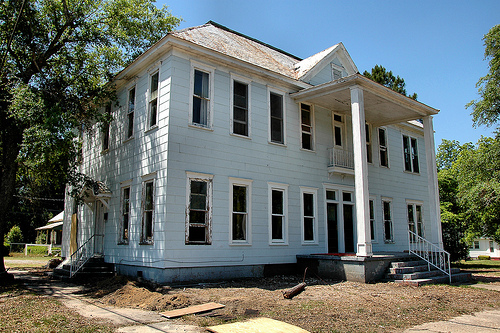
Ocilla’s first hospital, with 20 beds, was opened by Dr. Herman Dismuke* and Dr. Gabe Willis in 1914. It originally featured wrap-around porches. Jamie Wilcox Lovett and Cindy Griffin note that this was built by their great-grandfather, Robert Toombs Woolsey. It was made obsolete by a newer facility in the early 1930s and is now a private residence.
*Dr. Dismuke was the most beloved physician in Irwin County during his lifetime. He delivered thousands of babies, promoted modern health and sanitary practices through his work with the clinic at Irwinville Farms during the Great Depression and served as the county doctor.
Sandra Crouch Irons writes: My grandfather, Thomas A. Crouch, purchased this building to house his wife and family which included 7 children the first of which was born in 1898 and the last in 1911. I’m not exactly sure as to when he purchased the sanitarium, but I do have photographs of my father, Joseph P. Crouch, outside the back porch when he was about 12 which would have made the date around 1923. The sanitarium was never replaced around the 1930s because the Crouch family lived there. I am aware that my grandfather remodeled some of the interior, but the exterior remained basically the same until it was sold somewhere around the late 1980s/early 90s. I lived in and grew up in this house from 1954, when my father retired from the Marines and moved back to Ocilla, until I went to college in 1965. My husband, Stephen Irons, our daughter, Jennifer, and I continued to visit my parents and Aunt Joree who continued to live here until the house was sold.
Central Building [now known as the Powell Building]
The Georgia Lunatic Asylum opened on the outskirts of Milledgeville in 1842, its name only slightly more benign than the original “Lunatic, Idiot and Epileptic Asylum” conjured at its establishment in 1837. The need for such a facility was precipitated by the social reform movements popular in the early 19th century and at first, especially under the guidance of Dr. Thomas A. Green, patients were treated as humanely as possible. Green was responsible for attempting to humanize the plight of the asylum’s population, removing chains and restraints and even taking meals with them. Within its next century, though, the institution occupied over 200 buildings on nearly 2000 acres. At its peak, there were nearly 13,000 souls residing here, making it the largest state mental institution in the nation.
Walker Building
Unfortunately, after the Civil War, the institution experienced rapid growth, as many communities warehoused “undesirable” people from their communities to what was essentially a prison sentence at Milledgeville. This included thousands of veterans whose maladies deemed them impossible to treat in their resource-strained communities. This growth lead to a 100:1 physician to patient ratio that persisted for nearly a hundred years. In 1897, the facility came to be known as the Georgia State Sanitarium. But to most Georgians, it was simply known as “Milledgeville”. It was universally known in the state as a place to avoid. Walking the immense grounds today, one has to feel sorrow for the souls who were put away here, and a sense of anger at the horrible way we treated the mentally ill until the recent past.
Storehouse
By the 1960s, pharmaceutical advances helped reduce the number of patients who were subjected to such horrific treatments as electroshock therapy and lobotomies. For much of the 20th century, the institution was essentially an experimental laboratory of psychology, doing greater damage to its residents than good. The name of the property was changed to Central State Hospital in 1967 and by the 1970s, the population was in rapid decrease.
Auditorium
Today, fewer than 200 residents are in treatment here and a goal of phasing out the facility altogether is closer to reality. Most of the buildings are in ruin and while anyone is welcome to walk around the grounds, it’s illegal to enter any of the structures. A round-the-clock security team strictly enforces this mandate.
This was built as a one-story house but was expanded by Dr. Madison Monroe Holland (1860-1914) Holland in 1908 to accommodate his medical practice. Statesboro didn’t have a hospital at the time and the house served that purpose. Holland was one of Statesboro’s first doctors and briefly owned the Statesboro Drug Store, as well.
This hospital was chartered in 1936. Robert Jenks Taylor gave the city $100,000 for construction of the hospital in memory of his father, Dr. Eziekiel Henry Taylor, and his grandfather, Dr. Robert Newsome Taylor, Hawkinsville’s first physicians. It closed in early 1977 with the completion of a newer facility north of town. After being in a state of disrepair for many years it is presently being restored for use as apartments.
Rita J. McDaniel writes: Looks like the old Williams Home…on Williams Street….just off the corner of Lee Ave and Williams. Was used as a hospital at one time but was built as a residence, if memory serves me. It appears that the rear section of the house was a later addition.
Waycross Historic District, National Register of Historic Places
Anna King notes that this was the Elbert County Hospital in the First National Bank Building and it was on the 4th floor first. Then it took over the entire building in 1929. It closed in 1950 and a new one was built on Chestnut Street. Doug Anderson’s barber shop is located in the basement.
Elberton Commercial Historic District, National Register of Historic Places
The first owner of Oatland Island, after the Guale people, was John McQueen (1756-1807) and his wife, Anne Smith McQueen (1756-1809). John was fictionalized by Eugenia Price as Don Juan McQueen, in her best-selling 1974 novel of that title. McQueen was a land speculator and well-connected Revolutionary War patriot, who, after the war, fled to Spanish Florida to escape his debtors. Anne McQueen retained Oatland until her death. Their daughter, Eliza Anne McQueen Mackay (1778-1862) and husband Robert Gordon Mackay (1772-1816) maintained crops and enslaved laborers on the island for years thereafter.
The “main building” on Oatland Island (pictured above), was built as a retirement home in 1927 for the Order of Railroad Conductors and served that purpose until 1940. It is quite typical of institutional architecture of its era. It was subsequently purchased by the United States Public Health Service and served as a hospital in World War II, specializing in the treatment of venereal diseases, until the widespread application of penicillin for this purpose rendered a hospital unnecessary. Circa 1944, it was transferred to the Malaria Control in War Areas (MCWA) division of the Public Health Service. The MCWA evolved into the Centers for Disease Control (CDC) and until being surplussed in 1973, it was used as a development laboratory by the CDC. Martha Barnes adds this interesting bit of Savannah trivia: “People who read Midnight in the Garden of Good and Evil will remember the main building as where Luther Driggers worked and actually developed the chemical used in today’s flea collars, but in the book he was always about to poison Savannah’s water supply.“
The Chatham County Board of Education has owned it since then and it now serves over 20,000 students and visitors each year as an educational center for the surrounding Oatland Island Wildlife Center. It served as a set location for The General’s Daughter.
Carol Suttle, a Savannah native and Oatland’s most enthusiastic ambassador, contacted me several months ago about photographing the old water tower at the entrance to the center; it’s scheduled to be demolished and it’s one of her favorite structures on the island. Touring the island and its natural features with Carol and photographer Mike McCall was a real treat, and I hope to revisit in the future. Located just past downtown Savannah on the Islands Expressway (US 80), it’s often overlooked by tourists heading to Tybee Island but is well worth a visit. The site includes historic structures from the distant past as well as structures related to the government research that went on during the mid-1900s.
David Hamilton Delk, Jr. (1812-1880), built this cabin in 1837 in the Taylor’s Creek community near Gum Branch in Liberty County. It was moved and reconstructed here by the Youth Conservation Corps in 1979. The layout is of the Scots/Irish or “shotgun” design (not to be confused with the more common and more recent shotgun “house”), a vernacular form common in early Georgia.
Martha Phillips Youngblood writes that the corn crib pictured above was originally owned by her grandfather, Thomas Hilton Phillips, and was moved here from Treutlen County.
Several abandoned structures from the CDC era remain on the island.
This concrete structure indicates the danger of the work that was done here.
A hand-crafted boat from the 1970s can also be seen on the property.
Gopher Tortoises (Gopherus polyphemus), as well as wolves and bison can be easily seen on the property.
Beautiful Richardson Creek runs adjacent to the island.
Though I’m unsure as to the date of its construction, this building served as the first sanitary public hospital in Fitzgerald but was actually the second facility to serve as a hospital in the community. It was probably built before 1915. It has been used as an apartment house for many years and has recently been restored by Steve Mixon.